
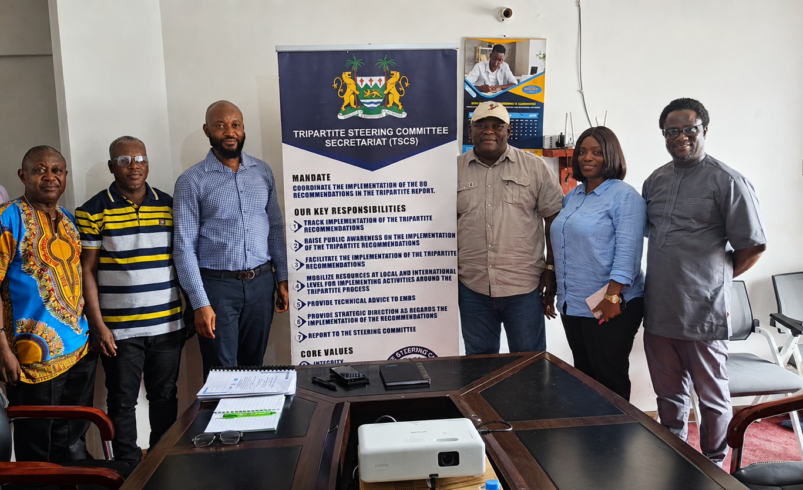
The Media Reform Coordinating Group (MRCG), in collaboration with BBC Media Action, has presented a series of reports and policy documents to the Tripartite Steering Committee Secretariat as part of efforts to support reforms of the Sierra Leone Broadcasting Corporation (SLBC) and strengthen community media in Sierra Leone.
The documents were presented during a ceremony at the Tripartite Steering Committee Secretariat in Freetown on Wednesday, 26 August 2026.
The initiative forms part of the Media Empowerment for Democracy, Inclusion and Accountability (MEDIA) project, funded by the European Union and managed by BBC Media Action.
Dr. Francis Sowa Esq., National Coordinator of the Media Reform Coordinating Group, said the organisation’s work had focused on identifying ways of putting into effect Tripartite recommendation (77) relating to the SLBC, the wider media sector and community media.
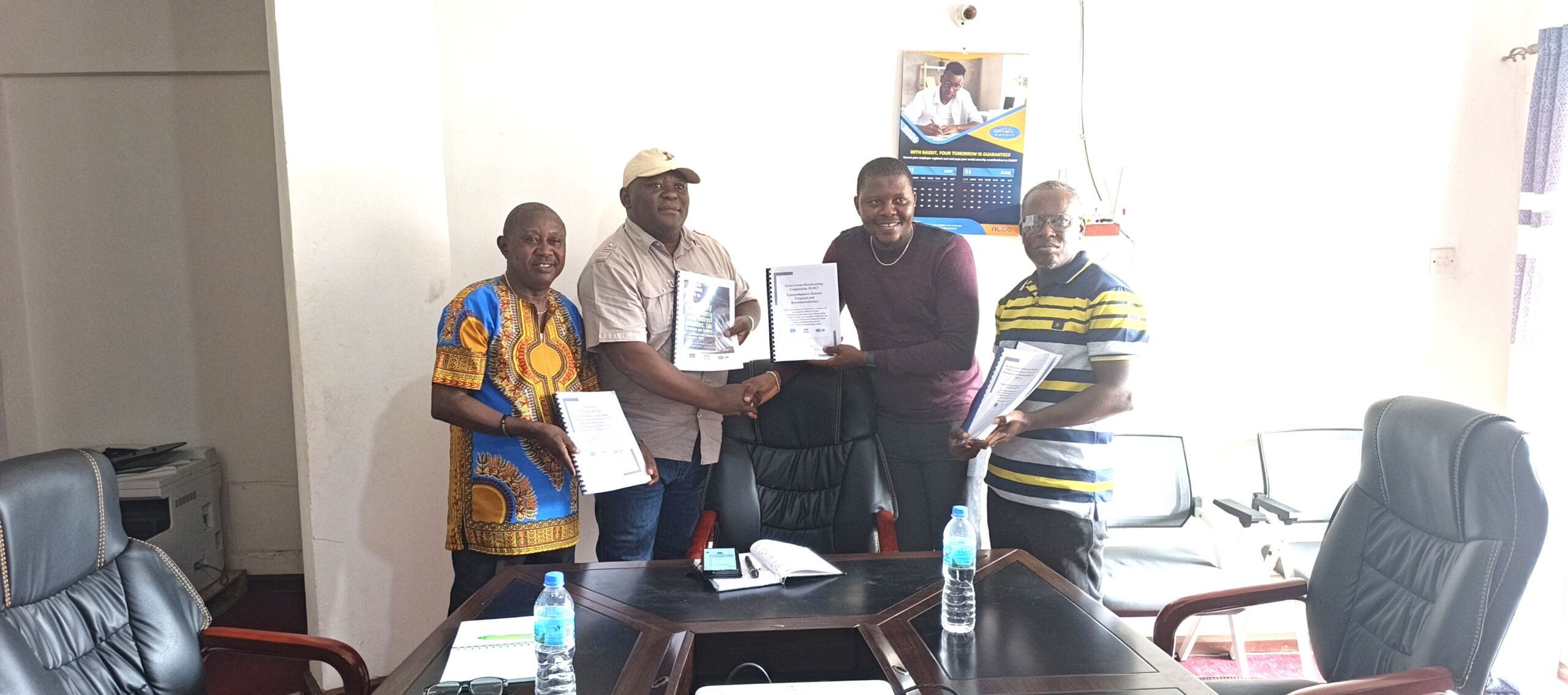
During the presentation, Dr. Sowa Esq. thanked the Secretariat for assigning staff members to participate in the consultation and validation process, saying they had supported the project by explaining the relevant Tripartite recommendations during consultations and engagements.
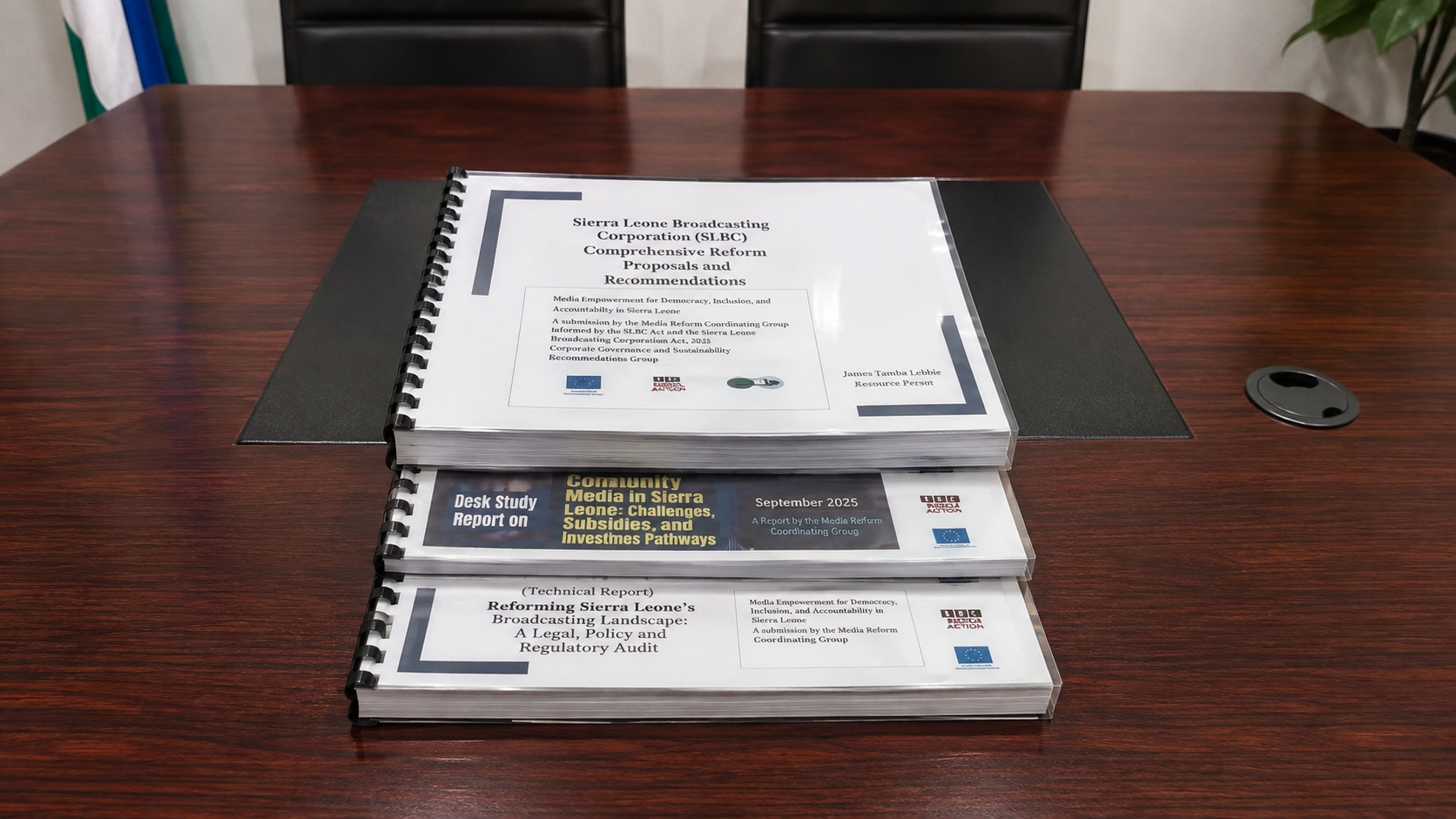
Seven sets of documents were presented, including four relating directly to the review and reform of the SLBC.
They include a nationwide consultation report summarising key issues and recommendations raised during consultations across Sierra Leone.
A literature review and benchmarking analysis on public service broadcasting was also produced, examining the SLBC against legislation, practices and public service broadcasting models and best practices in other countries.
Based on the nationwide consultations and international best practices identified through the review, a comprehensive reform proposal and recommendations were developed for consideration as part of the review of the SLBC Act.
Dr. Sowa Esq. said MRCG had also developed a comprehensive policy document intended to guide the review of the Act and inform the development of a new bill.
He said the policy document provides a broader framework for positioning the SLBC as a public service broadcaster in line with international best practices.
Dr. Sowa Esq. said soft copies of the documents would also be provided to the Secretariat following the symbolic presentation, to be uploaded on its website.
The presentation also focused on the sustainability of community media in Sierra Leone.
Dr. Sowa Esq. said a desk study on community media had been conducted alongside a survey examining the operations and challenges facing community media organisations.
The work particularly considered tax incentives, indirect subsidies and waivers available to community media.
According to the presentation, some community media organisations are unaware of existing waivers and subsidies and may therefore incur costs that could otherwise be avoided.
A technical paper was also developed from an economics and accounting perspective to examine the financial implications of proposed support mechanisms.
Dr. Sowa Esq. said the studies showed that some forms of support already exist within Sierra Leone’s laws and regulatory framework, but community media organisations may not always be aware of them or follow the necessary processes to benefit.
MRCG has consequently developed an advocacy outcome document containing short-, medium- and long-term recommendations.
Among the short-term recommendations is an awareness campaign to inform community media organisations about existing waivers and other available support.
The recommendations also call for a review of the governance and management structures of community media to ensure that organisations operating as community media genuinely serve the communities they represent.
MRCG is also advocating targeted indirect subsidies, including possible waivers of licensing and renewal fees charged to community media by relevant regulatory institutions and local councils, which could help strengthen the sustainability of community media while demonstrating government support for the sector.
Musa Sangarie, Country Director of BBC Media Action in Sierra Leone, said the submission represented a significant milestone following consultations, technical reviews and the development of recommendations.
Mr. Sangarie said the work relates directly to Recommendation 77 of the Tripartite recommendations and stressed that the presentation of the documents was not the end of the process.
He said BBC Media Action looked forward to supporting the next stages, including engagement aimed at advancing the proposed reforms through the appropriate legislative processes.
Mr. Sangarie also acknowledged the support of the European Union and said reforming the SLBC and strengthening Sierra Leone’s wider media sector remained important areas of engagement.
Receiving the documents, Thomas Ngolo Katta, Coordinator of the Tripartite Steering Committee Secretariat, thanked MRCG and BBC Media Action for their work and recognised their longstanding contribution to media reform, research and advocacy in Sierra Leone. He also thanked the European Union for providing funding to BBC Media Action and MRCG, enabling them to undertake the initiative.
Mr. Katta said the documents would provide further evidence for assessing progress in implementing the Tripartite recommendations.
He noted that implementation of the recommendations extends beyond constitutional reform and includes legislative and institutional reforms.
Mr. Katta said information contained in the documents would be considered in updating implementation progress and ensuring that Sierra Leoneans are informed about work taking place under the Tripartite recommendations implementation process.
He also expressed his commitment to continued engagement with the Ministry of Information and Civic Education and other relevant institutions on Recommendations 76 and 77.
“I will continue advocacy and engagement aimed at advancing reforms relating to the SLBC,” Mr. Katta said.
Mr. Katta also acknowledged the important role community radio stations have played in Sierra Leone, particularly in extending information to communities outside major urban and district centres.
He said community media requires sustainable mechanisms to enable them to continue providing information and supporting freedom of expression.
Mr. Katta recognised that government support, regulatory measures, private-sector assistance and corporate social responsibility initiatives could contribute to strengthening community media.
Mr. Katta assured MRCG and BBC Media Action that, further discussions would be held with relevant government officials on proposals concerning community media, including possible support mechanisms, waivers and other measures aimed at improving sustainability and move the reform process forward.


